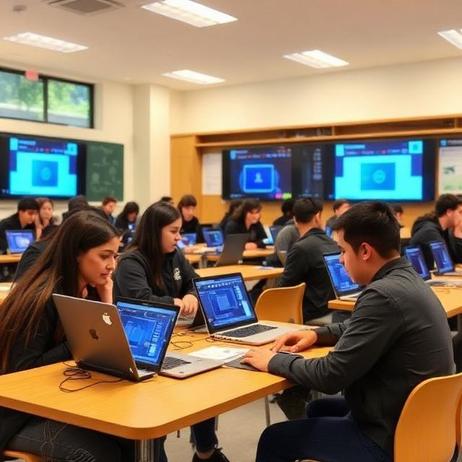
Artificial intelligence is rapidly transforming education, and boarding schools are at the center of the conversation. As generative AI tools like ChatGPT become common study aids, educators are navigating a complex question: how should schools balance innovation with academic integrity?
For families exploring residential education, understanding AI in Boarding Schools: How Students Are Using ChatGPT and What Schools Allow has become increasingly important. From supervised AI use in research to strict guidelines for essays and exams, boarding schools across the United States are developing thoughtful policies that reflect both opportunity and caution.
This article examines how students are using AI, what most schools allow, and how boarding schools are shaping responsible use in 2026.
Why AI Is Becoming Common in Boarding Schools
Boarding schools often adopt emerging educational technologies earlier than many other institutions. Their immersive academic environments, smaller class sizes, and close faculty mentorship allow schools to experiment with new tools while maintaining strong oversight.
Generative AI tools like ChatGPT can assist students in several ways:
- Brainstorming essay topics
- Clarifying complex academic concepts
- Summarizing research materials
- Practicing foreign language conversations
- Generating study guides or quiz questions
According to the National Center for Education Statistics, artificial intelligence and digital learning tools are becoming increasingly integrated into secondary education programs nationwide (nces.ed.gov).
For boarding schools, where students live and study on campus, faculty members can observe how AI tools affect learning in real time.
How Boarding School Students Are Using ChatGPT
In practice, most boarding school students are not using AI to replace learning. Instead, they are incorporating it as a study assistant, similar to how previous generations relied on search engines or online encyclopedias.
Common Student Use Cases
Students report using ChatGPT in several productive ways.
1. Study Support
AI tools can explain difficult concepts in multiple ways, helping students review material outside of class hours.
Examples include:
- Breaking down calculus steps
- Explaining historical events
- Reviewing scientific processes
2. Brainstorming and Writing Preparation
Students often use AI to generate topic ideas or outlines before writing essays themselves.
Typical workflow:
- Ask ChatGPT for topic suggestions
- Review and refine ideas
- Conduct independent research
- Write the essay without AI-generated text
3. Language Learning
International students and language learners frequently use AI for conversation practice and grammar clarification.
4. Coding Assistance
In STEM courses, AI can help students debug code or explain programming logic.
However, responsible schools emphasize that AI should support learning, not replace original work.
What Boarding Schools Typically Allow
Policies vary by institution, but most boarding schools have moved away from blanket bans. Instead, they are implementing structured AI guidelines.
Typical AI Policy Framework
| Allowed Uses | Restricted Uses |
|---|---|
| Brainstorming ideas | Submitting AI-written essays |
| Study guides and summaries | AI-generated homework solutions |
| Language practice | AI-generated lab reports |
| Coding assistance with explanation | Using AI during exams |
Many schools now treat AI similarly to calculators or research tools: permitted when used transparently and appropriately.
The U.S. Department of Education has encouraged schools to adopt balanced approaches that emphasize ethical use and digital literacy
How Boarding Schools Are Teaching Responsible AI Use
One advantage of the boarding school environment is the ability to integrate academic guidance with residential life.
Faculty advisors, dorm parents, and learning specialists all participate in shaping student habits.
Common AI Education Strategies
1. AI Literacy Courses
Some schools now offer workshops that teach:
- How generative AI works
- Its limitations and biases
- Ethical academic use
2. Transparent Citation Rules
Students may be required to disclose AI assistance in their work.
For example:
- Listing prompts used
- Identifying AI-generated summaries
- Explaining how the tool contributed to research
3. AI-Aware Assignments
Teachers are adapting assignments so students must demonstrate independent thinking.
Examples include:
- Oral defenses of written essays
- In-class writing sessions
- Multi-stage research projects
These strategies help ensure that learning remains authentic.
How Schools Detect Misuse
Despite growing acceptance of AI tools, academic integrity remains a priority.
Boarding schools typically rely on multiple strategies to detect misuse.
Detection Methods
Faculty familiarity with student writing
Teachers who work closely with students quickly notice changes in tone, vocabulary, or structure.
Process-based assignments
When assignments require outlines, drafts, and revisions, it becomes harder to submit AI-generated work.
AI detection tools
Some schools use software that attempts to identify AI-generated text, although these systems remain imperfect.
A 2024 report from Stanford University's Human-Centered AI Institute notes that AI detection technology should be used cautiously because accuracy varies (hai.stanford.edu).
As a result, most schools rely more heavily on educational approaches rather than surveillance alone.
Benefits of AI for Boarding School Students
When used responsibly, AI tools can provide meaningful academic advantages.
Personalized Learning
AI explanations can adapt to different learning styles, offering alternative approaches when textbooks fall short.
Increased Academic Confidence
Students who feel stuck on assignments can use AI for clarification before approaching teachers with more focused questions.
Support for International Students
Boarding schools often enroll students from dozens of countries. AI translation and language tools can help bridge communication gaps.
Extended Study Hours
Because students live on campus, they frequently study during evenings or weekends. AI can provide assistance when teachers are not immediately available.
These benefits help explain why many schools are embracing AI rather than banning it outright.
Risks Schools Are Watching Closely
Despite its advantages, AI also presents challenges that boarding schools must manage carefully.
Overreliance on AI
Students may be tempted to rely on AI explanations instead of engaging deeply with course material.
Academic Integrity Concerns
Submitting AI-generated writing as original work remains one of the biggest concerns.
Bias and Accuracy Issues
Generative AI systems sometimes produce incorrect or biased information.
The MIT Technology Review has reported extensively on the limitations of large language models and the importance of human verification in educational contexts (technologyreview.com).
Teaching students to question AI outputs is now considered an essential academic skill.
What Parents Should Ask Boarding Schools
Families evaluating residential schools in 2026 should ask about AI policies during the admissions process.
Important questions include:
- Does the school have a formal AI policy?
- Are students taught how to use AI responsibly?
- How do teachers adapt assignments for AI tools?
- What are the consequences for misuse?
Parents may also want to understand whether the school views AI primarily as a risk to manage or a tool for learning.
Schools with thoughtful policies typically emphasize education, transparency, and faculty mentorship.
What the Future of AI in Boarding Schools Looks Like
As AI tools continue to evolve, boarding schools are likely to remain testing grounds for responsible adoption.
Emerging trends include:
- AI-assisted tutoring programs
- AI-integrated writing instruction
- School-developed AI guidelines for research
- Expanded digital literacy curricula
Educators increasingly view AI as a permanent part of the academic landscape, not a temporary challenge.
Schools that succeed will be those that help students develop judgment, ethics, and critical thinking alongside technical skills.
Frequently Asked Questions
Are boarding schools banning ChatGPT?
Most boarding schools are not banning ChatGPT outright. Instead, they allow limited use for research, brainstorming, and study support while prohibiting AI-generated assignments.
Can students use AI for homework?
It depends on the assignment. Many schools allow AI for idea generation or concept explanations but require students to produce their own written work.
How do teachers know if students used AI?
Teachers often recognize changes in writing style or require drafts and revisions that show the student’s thinking process.
Is learning AI skills important for students?
Yes. Many educators believe AI literacy will become as essential as digital literacy, helping students navigate a technology-driven world responsibly.
Final Thoughts
The conversation around AI in Boarding Schools: How Students Are Using ChatGPT and What Schools Allow reflects a broader shift in education. Rather than treating artificial intelligence solely as a threat, many schools are embracing it as a powerful learning tool.
Boarding schools, with their close-knit academic communities and strong mentorship culture, are particularly well positioned to guide students in using AI responsibly.
For parents and students exploring residential education in 2026, the most important question is not whether schools allow AI, but how they teach students to use it wisely.