Small class sizes work. In fact, small class sizes are one of the main reasons why you send your child to boarding school. Here are some reasons why small class sizes are so important.
1. There's nowhere to hide in a small class.
Imagine your child is in a large high school class of 30-35 students. She's not good at math. Most of the students in her class don't understand math and could care less about it. So your daughter hangs out in the back of the class, keeps quiet and tries to pay attention. The distractions and cutting up going on around her mitigate against any meaningful learning. Your daughter falls further and further behind in math. Sadly, public school class sizes continue to increase in many districts as schools struggle with staffing shortages and budget pressures in 2026. Class sizes of 30-35 students remain common in many public high schools.
Contrast that learning environment with 12-14 students seated around a Harkness Table in a boarding school. A Harkness Table is an oval table. The teacher sits at the table with his students. Immediately students are placed in a situation where they have no choice but to engage and interact with each other and with their teacher. A Harkness table creates a climate for learning.
Implicit in the small teaching groups is a climate of tolerance. The views of each individual are expressed. Critical thinking skills are practiced and polished precisely because the small group allows time for that. Large groups make developing those skills a challenge. Drawing out each student in a large group is a challenge. Drawing out students in a small group is easy, effective, and expected.
Your child will be noticed when she sits at a Harkness table. She will be helped when she needs help. She will be encouraged to express her point of view and to defend her beliefs. That develops self-confidence and poise as she progresses toward adulthood.
Small classes really involve students. Small classes surround students with attention and encouragement. Teachers provide attention and encouragement as part of how they guide students' learning. But the small group fosters sharing and even a sense of teamwork as concepts are explored in the give and take of discussion.
Because students learn in different ways, the teacher can take all the time needed to present the material being taught in a variety of ways appropriate to a small class of students. That is much more difficult to do with a large class.
Many boarding schools continue to use discussion-based learning models inspired by Phillips Exeter Academy, where the Harkness method remains central to classroom instruction in 2026.
For more insight into boarding school academics, read Why Boarding School?.
Parents researching academic environments may also find value in Benefits of Boarding School: 10 Advantages for Students, which explores how residential education supports long-term student growth.
2. You can actually teach when classes are small.
Very few teachers enjoy managing a large class. It's very difficult to do. Unfortunately, that's what you end up doing when confronted with a large class of students. It's not easy managing 25-35 students of any age in any situation.
Behavior problems in a small class are the exception rather than the rule. Behavior problems in a large group of students of any age can quickly escalate out of control. The teacher often has several different achievement levels to work with. That's tricky enough to handle under the best of circumstances, but in a large class, it becomes a major challenge.
Students really do learn more when classes are small. They learn faster. They progress through the material more quickly. They soon develop the confidence to express their ideas and opinions without fear of scorn and retribution from their peers.
Small classes help create a climate for learning. After all, the students are there to learn.
Since teaching has so much to do with a teacher observing how a student learns and how he is retaining information, a small class allows a teacher to really observe closely and carefully monitor how individual students are doing. The quicker response makes for greater progress. Put another way, children learn more in a small class because the teacher can do more teaching and can assess the effectiveness of teaching better.
After all, teachers are exemplars. Students listen carefully to what is being said but are always more impressed when adults practice what they preach. Allowing a teacher to teach in a smaller, more intimate situation where students and teachers can interact spontaneously enriches and enhances learning.
That Spanish phrase which was so difficult to pronounce flows effortlessly when you, your classmates, and the teacher can polish the pronunciation, create the correct labial and consonant sounds, and so on. Listening to a Mozart symphony in music appreciation class takes on new dimensions when you are sitting next to your classmates and your teacher and observing their reactions to the music.
While a teacher must teach, he is going to be a much more effective teacher in a small group situation that fosters happy, relaxed, enthusiastic learning.
Recent education research from the National Association of Independent Schools continues to show that stronger student-teacher relationships improve both academic performance and student well-being.
Research from the National Center for Education Statistics also continues to highlight the relationship between student engagement and academic achievement in smaller learning environments.
You may also want to explore A Survival Guide for Boarding School Teachers for additional perspective on how small learning environments help teachers succeed.
Families comparing school options can also read Boarding School vs Day School: Key Differences for Families to better understand the differences in academic structure and student life.
3. What are the social benefits of small class sizes?
Small class sizes impact how children interact with each other. Small classes afford students the chance to really develop closeness and a cooperative spirit. Those are important lessons for children to learn. As adults, they will have to get along and cooperate with coworkers and other colleagues in work and professional situations.
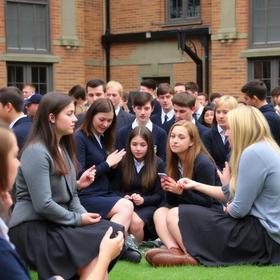
Appreciating diversity is very important in today's workplace. Notice the closeness of students and teachers in this small class situation. It is much harder for factions to thrive in a small class setting. The class is generally more homogeneous and unified in spirit and focus.
Small classes help you really get to know your classmates. Knowing and understanding your classmates allows you to develop lasting friendships.
In 2026, boarding schools continue to emphasize community-building, collaboration, and student wellness as essential parts of residential education. Small class environments support those goals naturally by encouraging communication, empathy, and teamwork.
Organizations such as the Association of Boarding Schools continue to emphasize the importance of personalized learning and residential community experiences for student development.
The truth is that the small classes at private schools are logical extensions of an educational philosophy which believes that educating the whole child is vitally important. In other words, it's not just a matter of teaching math or Spanish verbs, but rather a matter of teaching those subjects and everything else within a larger context.
Giving a child a sense of who she is and where she fits in is part of that mission. When we accomplish that, we equip a child for a lifetime of achievements. The intimate, small class allows that kind of teaching and learning to take place.
For more information about boarding school life and academics, visit Boarding School Review.
Conclusion
Small class sizes work because they make learning personal. In a small boarding school classroom, students are expected to participate, teachers can respond quickly, and classmates learn to listen to one another. That combination builds academic confidence, stronger relationships, and the habits of mind students need for college and adult life. For families considering boarding school in 2026, small classes remain one of the clearest advantages of the boarding school experience.